
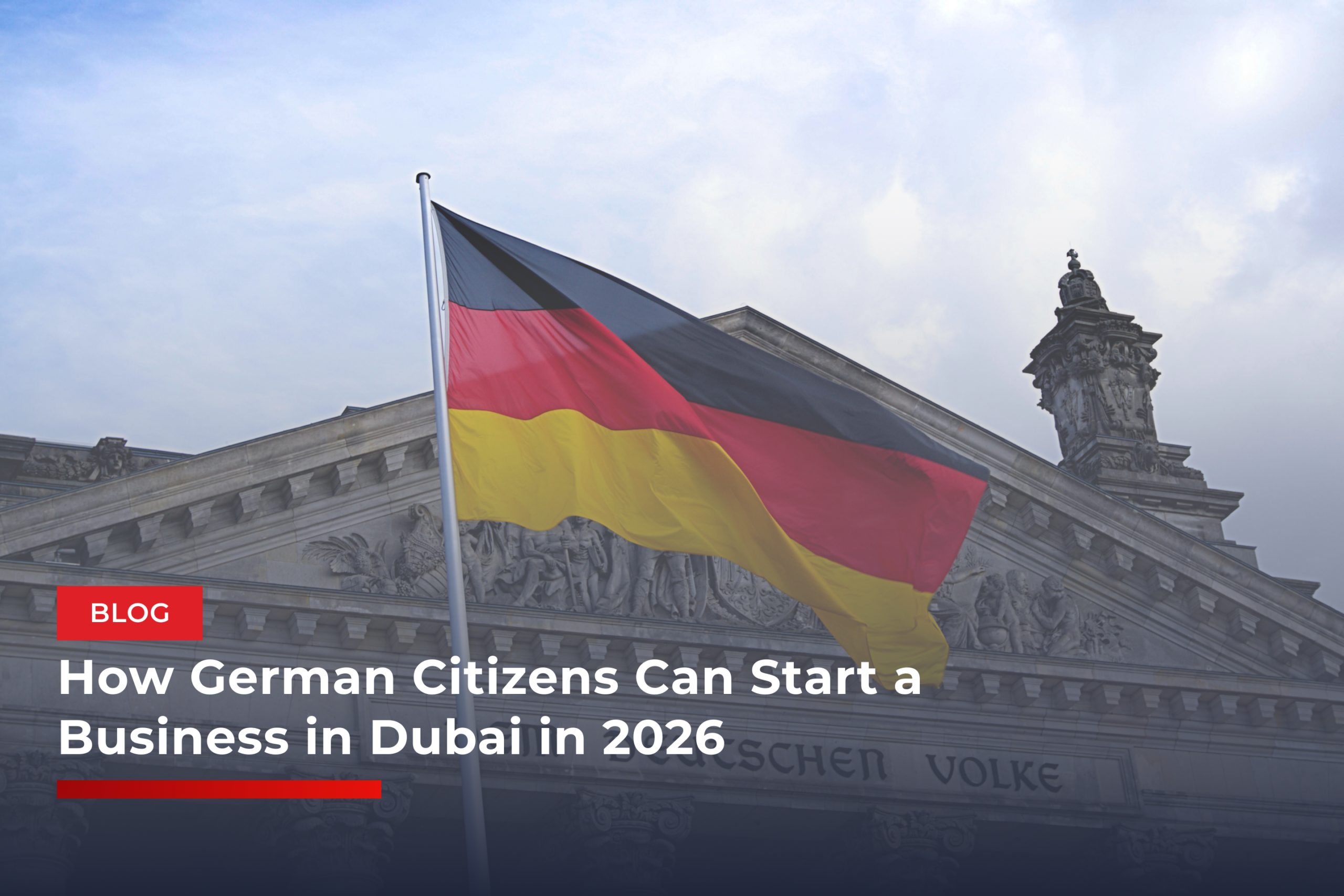
Dubai remains a top destination for global entrepreneurs—and German nationals are no exception. With its pro-business environment, 0% personal income tax, and strategic access to markets across the Middle East, Asia, and Africa, starting a business in Dubai in 2026 offers German citizens tremendous opportunities.
This guide outlines the step-by-step process for Germans to set up a company in Dubai, whether in the mainland, free zones, or offshore jurisdiction.
Step 1: Decide on the Right Jurisdiction
Dubai offers three business setup zones:
1. Mainland (Onshore)
- Allows you to operate anywhere in the UAE and internationally
- Regulated by Dubai’s Department of Economy & Tourism (DET)
- Requires office space and permits hiring unlimited staff
- Ideal for trading, contracting, retail, and government contracts
2. Free Zone
- 100% foreign ownership (no Emirati sponsor needed)
- Operate within the Free Zone or export services/products internationally
- Excellent for tech, consulting, logistics, and e-commerce
- Regulated by individual Free Zone Authorities (e.g., DMCC, Dubai South, DIFC)
3. Offshore
- Ideal for holding companies, international trading, or IP management
- Cannot do business inside the UAE
- Provides financial privacy and asset protection
Recommendation for Germans: Most new entrepreneurs from Germany prefer Free Zone setup due to ease, ownership, tax benefits, and simplified paperwork.
Step 2: Choose Business Activity
Each company in Dubai must declare its licensed activities, such as:
- Management consulting
- Software development
- Real estate brokerage
- Online retail / e-commerce
- Import/export
- Event management
Certain sectors (e.g., finance, legal, medical) require additional approvals or regulatory oversight.
Step 3: Reserve Your Company Name
Business names in the UAE must comply with government naming conventions:
- No offensive or religious language
- Must not conflict with existing names or trademarks
- Avoid abbreviations (e.g., “M. Müller GmbH”)
- Must reflect the business activity (e.g., “Berlin Tech FZCO”)
The name is reserved with the Free Zone Authority or the DET (for mainland).
Step 4: Apply for a Trade License
You’ll need a business license to legally operate. Options include:
- Commercial License – For trading businesses
- Professional License – For service providers and consultants
- Industrial License – For manufacturing
- E-commerce License – For online businesses
The license can be obtained in as little as 3–7 working days if documents are in order.
Step 5: Submit Legal Documents
Typical documentation for German citizens includes:
- Valid passport copy
- Passport-size photographs
- Entry stamp or UAE visa copy (if applying from within UAE)
- Proof of address (Germany or UAE)
- Business plan (optional, depending on activity)
- Application forms from Free Zone or DET
No need for German translations—English is accepted across all government entities.
Step 6: Open a Corporate Bank Account
Once licensed, apply for a UAE business bank account. Popular banks include:
- Emirates NBD
- Mashreq Bank
- ADCB
- RAKBANK
- WIO (great for startups and digital-first entrepreneurs)
You’ll need:
- Trade license
- Passport and Emirates ID
- Office tenancy agreement (if applicable)
- Business plan or sample invoices
German nationals benefit from strong bilateral banking ties between the UAE and EU, making account approval smoother.
Step 7: Apply for UAE Residency Visa (Optional)
Your company license allows you to apply for:
- Investor visa (valid for 2 or 10 years)
- Employee visas (if hiring staff)
- Dependent visas (for family)
To get the visa, complete:
- Medical fitness test
- Emirates ID biometrics
- Health insurance
- Visa stamping in passport
Residency enables you to:
- Sponsor family
- Open personal bank accounts
- Lease property
- Access healthcare and driving license
Step 8: Understand UAE Tax Compliance in 2026
The UAE now has 9% corporate tax on profits exceeding AED 375,000. You must:
- Register with the Federal Tax Authority (FTA)
- Maintain bookkeeping and accounting systems
- File annual tax returns
VAT registration is also mandatory if your turnover exceeds AED 375,000.
Note: Many Free Zones offer 0% tax rates for Qualifying Free Zone Persons (QFZP), depending on activity and structure.
Benefits for German Citizens Starting a Business in Dubai
- 0% personal income tax
- 100% foreign ownership (in most sectors)
- German-friendly infrastructure – Germany is one of UAE’s key trading partners
- Direct flights from Frankfurt, Munich, Berlin to Dubai
- Bilingual business environment (English + Arabic, with German widely understood in B2B circles)
- UAE residency with access to world-class lifestyle, healthcare, and safety
Final Tips for a Smooth Setup
- Work with a trusted business setup partner in Dubai who can handle paperwork, PRO services, and bank appointments
- Choose the right Free Zone based on your business needs (DMCC for trading, IFZA for services, DIFC for finance)
- Prepare for tax compliance from day one (hire an accountant or use cloud-based systems)
- Build your digital brand early with a website, business email, and UAE business listings
- Learn about cultural norms and local business etiquette to build trust and relationships
Ready to Start Your UAE Business Journey?
Dubai continues to position itself as a global business hub, and the UAE government actively welcomes investors from Germany. By taking a structured approach and following the steps outlined above, German entrepreneurs in 2026 can launch quickly, operate compliantly, and scale globally.